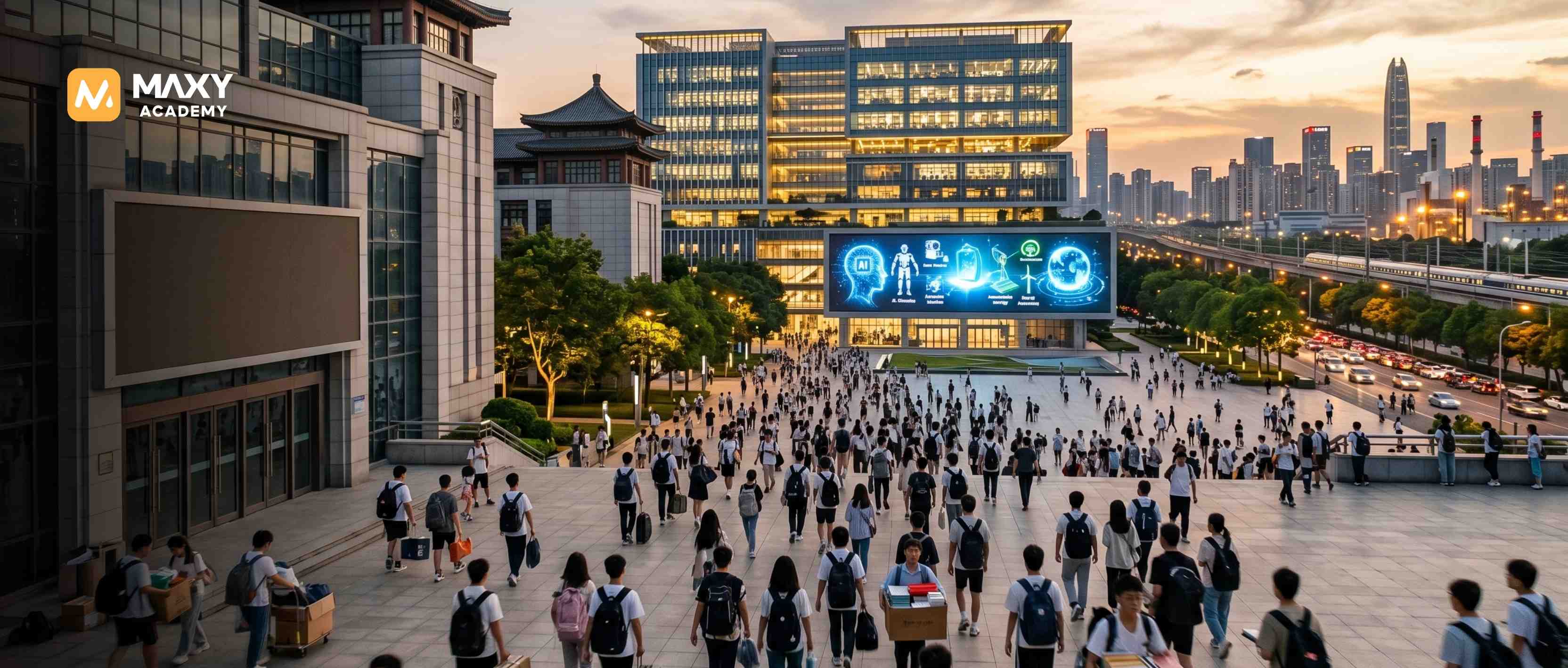
Higher education is entering one of the most significant periods of transformation in recent decades.
While many countries are still debating the future of university curricula and how education should adapt to evolving industry needs, China has taken a far more aggressive approach. Throughout 2024, hundreds of academic programs across Chinese universities were discontinued and replaced with new programs designed to align with emerging technologies, industrial transformation, and the future economy.
For some, this may seem surprising. However, for those closely observing education and workforce trends, it is a clear indication that the world of work is changing faster than many educational institutions can adapt.
One of the most notable examples came from Sichuan University, which announced the closure of 31 academic programs in a single restructuring effort. This was not an isolated case. Across the country, universities have been undertaking large-scale academic reforms. China's Ministry of Education reported the removal of approximately 1,670 programs while simultaneously approving a similar number of new programs focused on future-oriented industries and technologies.
This development highlights a fundamental shift in the role of higher education. Universities are no longer viewed solely as institutions that grant degrees; they are increasingly expected to function as strategic talent engines that support national economic priorities and industrial competitiveness.
Interestingly, the programs being phased out are not limited to traditionally low-demand fields. Several engineering, science, business, and even creative arts programs that were once considered highly valuable have also been reduced or discontinued at various institutions.
This suggests that the success of an academic program is no longer measured by its historical importance or popularity. Instead, its value is increasingly determined by one critical question: Will the skills taught today still be relevant five to ten years from now?
At the same time, China is expanding investment in programs related to Artificial Intelligence, Robotics, Intelligent Manufacturing, Data Science, New Energy Engineering, Digital Economy, Quantum Information, and other emerging disciplines.
The direction is clear. Education is moving beyond preparing graduates for an industrial economy or even a knowledge economy. It is now preparing talent for what many experts describe as the Intelligence Economy.
In previous generations, universities focused on producing graduates with theoretical knowledge and standardized professional skills. Today, however, advances in AI and automation are rapidly changing the nature of work. Tasks that rely heavily on routine processes, information retrieval, and procedural execution are increasingly being performed by machines.
As a result, employers are shifting their focus toward more complex human capabilities.
Organizations now seek individuals who can combine technology with creativity, analyze data while understanding human behavior, and solve problems that do not have predefined solutions. Critical thinking, adaptability, interdisciplinary collaboration, and the ability to work effectively with AI are becoming some of the most valuable skills in the modern workforce.
China’s educational restructuring reflects a recognition of this reality.
For countries like Indonesia, these developments offer an important lesson. Many university programs and curricula were originally designed to meet the demands of industries that existed decades ago. Meanwhile, technologies such as AI, automation, robotics, and digital transformation are advancing at an unprecedented pace.
The greatest challenge may not simply be graduate unemployment. A more concerning issue is the rise of what many experts call irrelevant graduates—individuals who possess academic credentials but lack the competencies required by modern industries.
As companies continue automating routine work and reducing middle-skill positions, demand for multidisciplinary talent is expected to increase significantly. Employers are no longer looking for professionals with expertise in only one narrow field. Instead, they seek individuals who can bridge disciplines and apply diverse knowledge to create innovative solutions.
This shift suggests that the future of education may no longer revolve around rigid academic boundaries. Instead, interdisciplinary learning models are likely to become increasingly important.
Emerging combinations such as AI and Healthcare, AI and Education, AI and Agriculture, Data Science and Public Policy, Green Energy and Digital Systems, and Robotics and Advanced Manufacturing demonstrate how future careers will be built at the intersection of multiple disciplines.
In this new landscape, success will not be defined solely by the name of a degree program. What matters most is an individual's ability to integrate technology, data, creativity, and problem-solving into a unified skill set that can adapt to changing industry demands.
Ultimately, the closure of hundreds of university programs in China should not be viewed as a sign of educational decline. On the contrary, it represents a willingness to adapt to profound global changes.
The world is rapidly moving toward an era shaped by AI, automation, and digital transformation. In such an environment, maintaining outdated educational structures may create even greater challenges by producing graduates who struggle to remain competitive in the labor market.
The most important question is no longer:
"Which university major is popular today?"
Instead, the question that students, educators, and policymakers should be asking is:
"Which human competencies will remain valuable when AI, robotics, and automation take over a significant portion of routine work?"
The answer to that question may determine not only the future of education, but also the future competitiveness of nations, industries, and individuals around the world.
Prepare for the Future with MAXY Academy
The future of work is evolving faster than ever. As technology continues to reshape industries, staying relevant requires continuous learning, adaptability, and a deep understanding of emerging trends.
At MAXY Academy, we provide insights, learning programs, and industry-focused resources covering Artificial Intelligence, Digital Transformation, Data, Innovation, and Future Skills to help individuals and organizations thrive in a rapidly changing world.
Explore more articles from MAXY Academy and start building the skills that will define success in the age of AI and the Intelligence Economy.