Bung Hatta University Lecturers Develop AI to Grade Student Essays: How Accurate Are the Results?
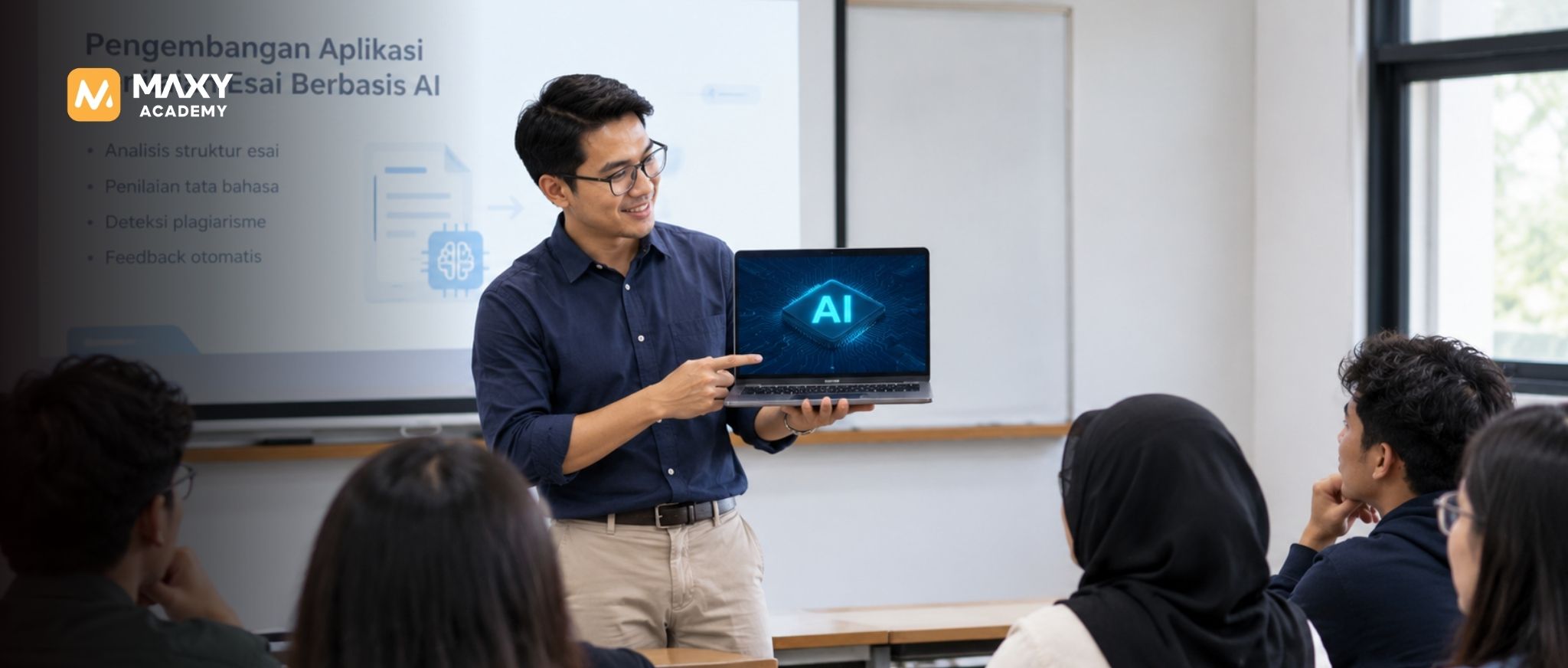
The use of Artificial Intelligence (AI) in education continues to evolve. AI is no longer limited to helping students find information or prepare learning materials. It is now being developed to support academic assessment and evaluation.
One such innovation comes from Bung Hatta University, where a team of lecturers has developed an AI-powered prototype called Automated Essay Scoring (AES). The application is designed to help lecturers evaluate student essays more efficiently and consistently.
The research is led by Ade Fitri Rahmadani, S.Pd., M.Pd.T., alongside three other lecturers and involving two students. The project is funded through Bung Hatta University's 2026 Internal Research Funding Program.
How Does AI Evaluate Student Essays?
Manually grading essays can be time-consuming, particularly when lecturers need to review dozens or even hundreds of student responses while maintaining consistent assessment standards.
To address this challenge, the AES application utilizes Artificial Intelligence and Natural Language Processing (NLP).
These technologies are designed to analyze student essays based on several aspects, including:
-
Language: Analyzing language use and expression in student responses.
-
Writing Structure: Examining how ideas and arguments are organized.
-
Content Relevance: Evaluating whether the answers align with the questions or learning materials.
Through this approach, the application is expected to support lecturers in the assessment process, particularly when handling large volumes of essays.
Initial Testing Shows Promising Results
During development, the research team conducted a needs analysis, expert validation, and practicality testing to evaluate the prototype's feasibility.
The research reported several notable findings:
-
85.50% in the needs analysis, indicating a strong demand for the application.
-
0.88 Aiken's V for expert validation of the content aspect.
-
0.88 Aiken's V for expert validation of the media aspect.
-
94.67% in practicality testing involving 30 students.
These results indicate positive findings in terms of application needs, expert validation, and user practicality.
However, one important aspect still needs to be considered.
How Accurate Is AI at Grading Essays?
Although the initial testing results are promising, they do not necessarily prove that the application can already grade essays accurately.
The research team explained that the development is still at the prototype stage. Further testing is needed to measure algorithm accuracy and empirically evaluate the application's effectiveness in improving grading efficiency.
This means that expert validation scores and practicality test results should not be interpreted as evidence that AI-generated scores are already equivalent to those given by lecturers.
Essay assessment involves more than evaluating sentences. It also requires understanding students' ability to construct arguments, connect concepts, demonstrate comprehension, and develop critical thinking.
Therefore, the use of AI in academic assessment still requires further evaluation to ensure that its results are reliable and accountable.
AI as a Supporting Tool, Not a Replacement for Lecturers
The development of the AES application at Bung Hatta University demonstrates how AI is beginning to take on more practical roles in higher education.
This technology has the potential to reduce lecturers' administrative workload, allowing them to dedicate more time and attention to the learning process.
At the same time, lecturers remain essential in ensuring that assessments consider context, argument quality, and students' overall understanding.
Ultimately, the success of AI adoption in education is not determined solely by technological sophistication, but also by how responsibly and appropriately the technology is implemented.
This innovation serves as an example of how collaboration between lecturers, students, and technology can create new opportunities for the future of higher education in Indonesia.
Source: Bung Hatta University
https://bunghatta.ac.id/news/dosen-universitas-bung-hatta-kembangkan-aplikasi-penilaian-esai-berbasis-ai